
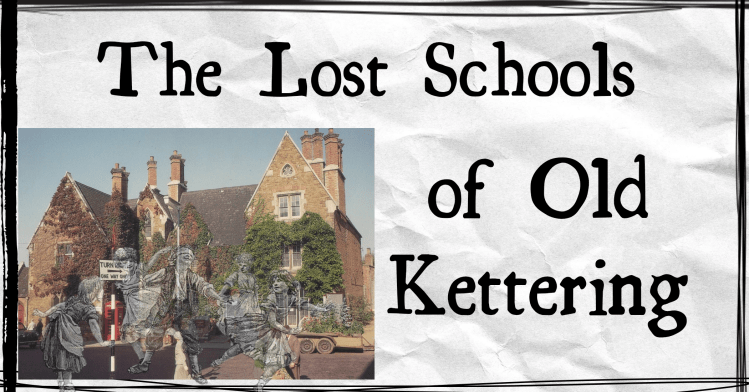
History is all around us, the past leaves footprints everywhere.
Sometimes a footprint is a hole in the ground, or a space where something once was. There’s a number of school buildings in Kettering which have disappeared over the years, for various reasons…
Types of Schools + A Timeline of the Schooling System
If you want to skip this section, click here.
1530s onwards – Parish Instruction
Parish priests or curates were expected to teach boys the catechism and basic literacy.
1570s – Grammar Schools
Endowed schools (like Kettering Grammar School, founded 1577) taught Latin and later broader subjects, usually for boys 11+.
Early 1700s – Charity Schools
Small churchor society-funded schools gave poor children free lessons in reading, writing, religion, and (for girls) sewing.
1808 – British Schools
Set up by Non-Conformists, open to children of all denominations. Often used the monitorial system (older pupils helping to teach).
1811 – National Schools
These schools were run by the Church of England, through the National Society for Promoting Religious Education. This was founded in 1811, partly is response to the foundation of British Schools – the Church of England didn’t want religious influence over the poor to slip out of its hands.
1870 – School Boards
The Elementary Education Act of 1870 set up elected School Boards in towns and cities. These boards could build new schools wherever church schools (National or British) were not enough. The schools they ran were called Board Schools.
They gave basic education in reading, writing, and arithmetic, and were open to all children, no matter what church (or chapel) their family attended.
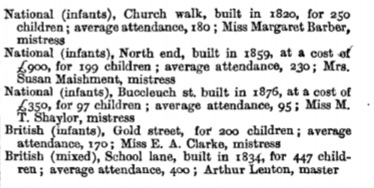
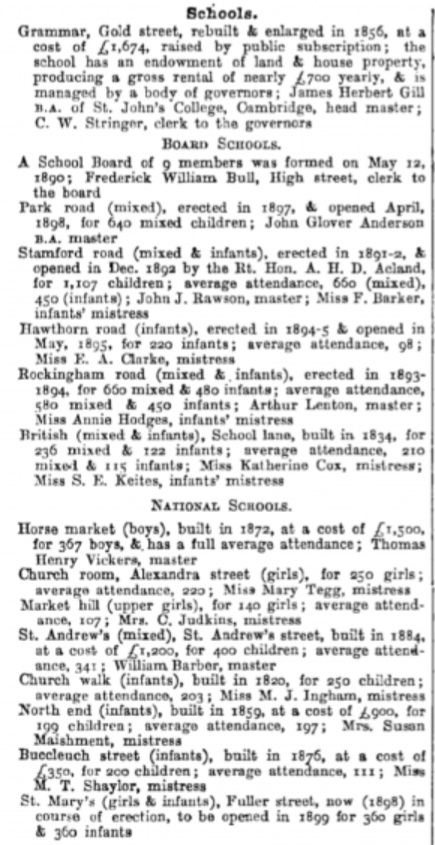
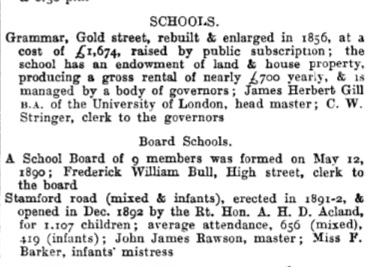
Kettering School Board was formed in 1890.
1870 – Elementary Schools
“Elementary Schools” was an umbrella term for Board, British, and National Schools.
Late 1800s–Early 1900s – High Schools
Often for girls, but sometimes for boys; taught broader subjects and prepared older pupils (11–16/18) for jobs or further study. They were often functionally equivalent to Grammar Schools.
1902 Education Act
This Act abolished School Boards, and brought all schools (Board, National, British, and others) under local authority control for funding and inspection.
National Schools continued but were now classed as “provided” (Council) or “non-provided” (Voluntary Aided) schools.
Many still exist today as Church of England Voluntary Aided or Voluntary Controlled primary schools.
1944 – Grammar Schools and the 11-plus
The Butler Act (1944) reorganised education into three types: Grammar, Technical, and Secondary Modern. To decide who went where, children sat the 11-plus exam at age 11.
Grammar Schools became selective: only children who passed were allowed to attend, often with a path to university.
This replaced the older mix of local entry tests, scholarships, or fee-paying places.
1944 – Secondary Modern Schools
For most children after the 11-plus exam. Focused on practical skills and general education until school-leaving age.
1944 – Technical Schools
Technical Schools were supposed to give children a practical and scientific education, preparing them for jobs in engineering, building, design, or applied science.
They often taught subjects like metalwork, mechanics, and technical drawing at a higher level than Secondary Moderns.
1960s onwards – Comprehensive Schools
Brought all pupils together in one school, without the 11-plus, teaching a wide range of subjects up to 16 or 18.
Mixed, Boys, and Girls
There was a time that Junior and Senior Schools were expected to be single sex – as it sounds, Mixed would denote a school which was for both.
Kettering Grammar School
Gold Street
1856 – 1964
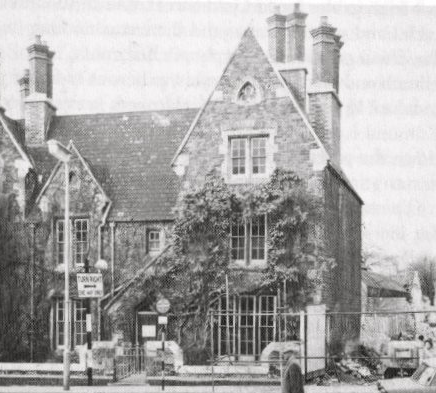
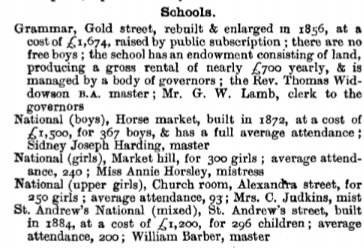
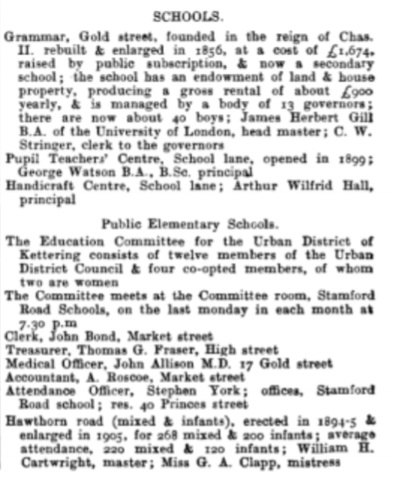
Kettering Grammar School was founded in 1577.
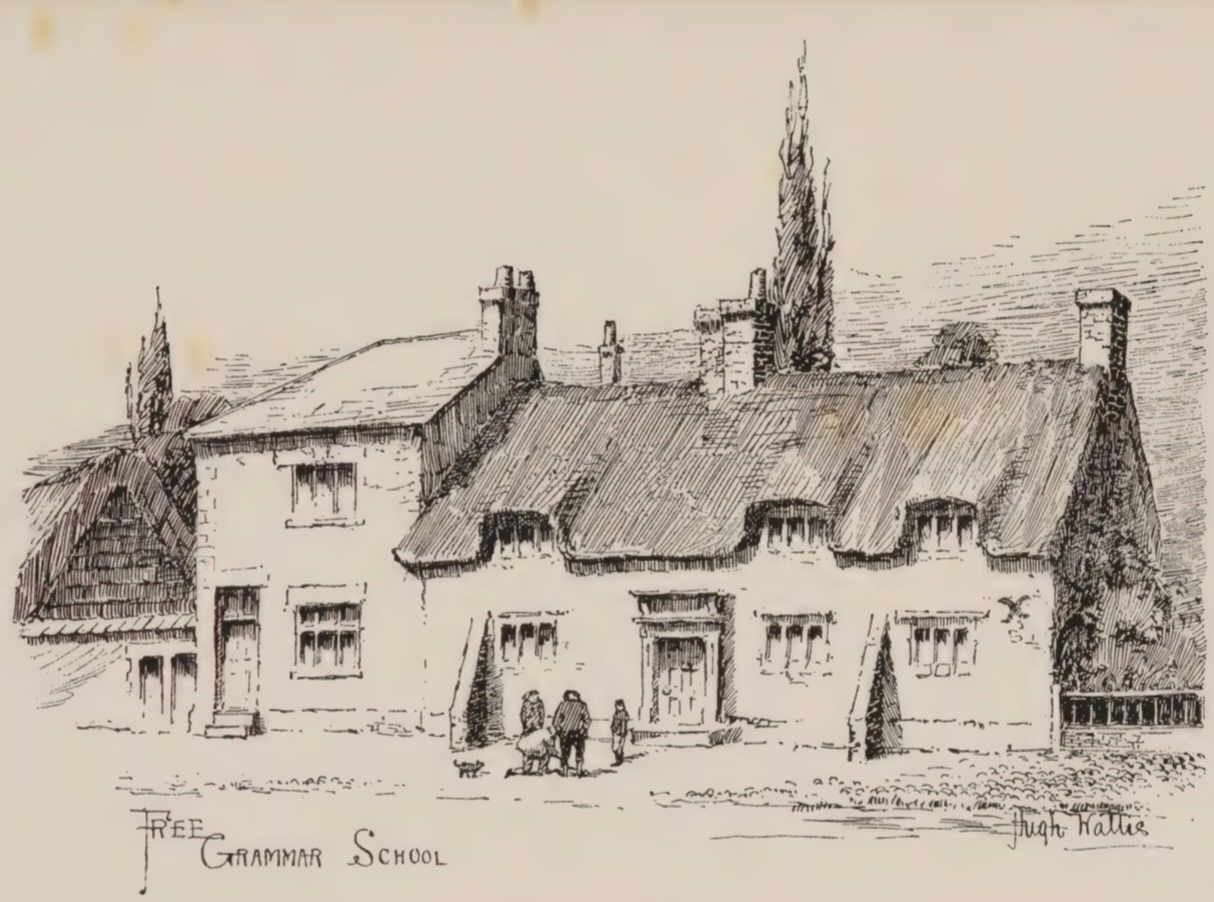
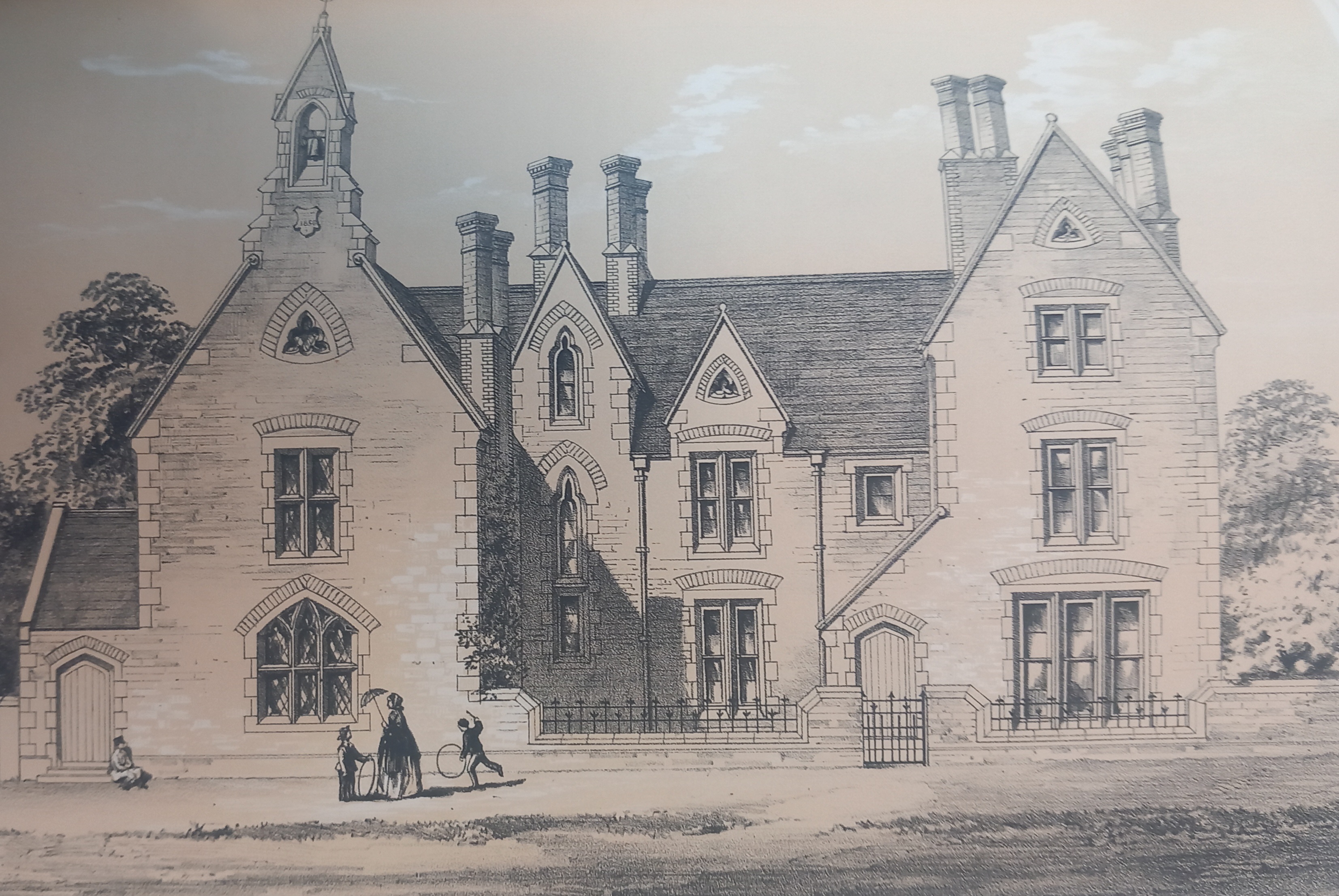
The original building stood until it was almost falling down, and was rebuilt in 1856.
The school moved into the more spacious and modern building on Bowling Green Road in 1913.
The school building lived on, first as the home and surgery of a doctor, and was then the council’s surveying department.
It was demolished without warning or consultation in 1964, to make room for shops.
Local historian and heritage campaigner Tony Ireson had been a prominent local voice calling for the building to be preserved. Carrying out the demolition on a Sunday is widely seen as an under-handed move.
Kettering Grammar School
Kettering Boys’ School
Windmill Avenue
1962 – 2007
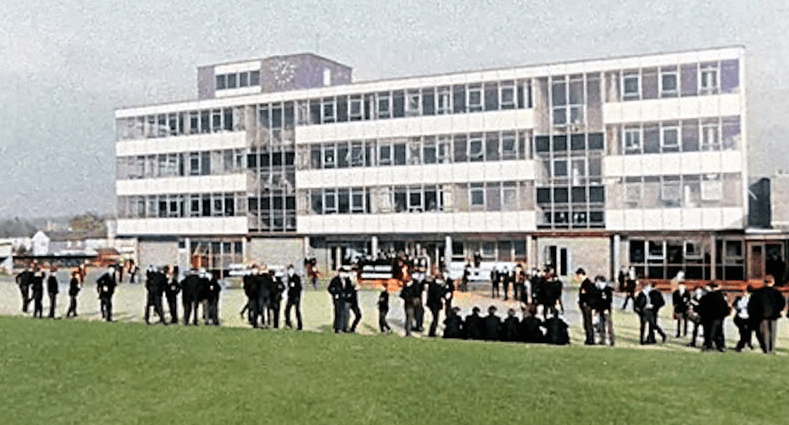
This was Kettering Grammar School‘s third home – they had spent 1913 – 1962 in the building that now houses the council offices on Bowling Green Road: see The Former Schools of Old Kettering.
Both moves were prompted by the need for more spacious and modern schooling facilities.
Kettering Grammar School absorbed Stamford Road School in 1976, together becoming a comprehensive called Kettering Boys’ School.
The school’s long and storied life ended in 1993, and the site was taken over by Tresham College.
The building was demolished in 2007 to make way for Tresham Institute‘s new building.
The centuries-long legacy of the school lives on the form of a charity. The Kettering Old Grammar School Foundation currently provides funding for local educational causes. It was formed in 1911, to manage the administration of the school and its properties.
According to a Map of Kettering (1821) and its reference key, these are the properties which belonged to the school.
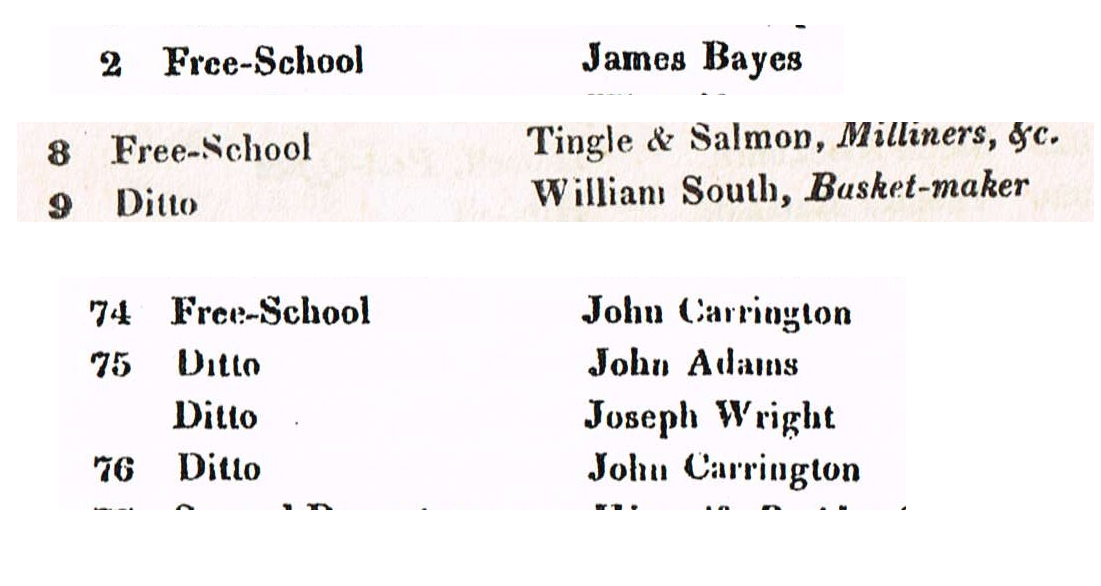
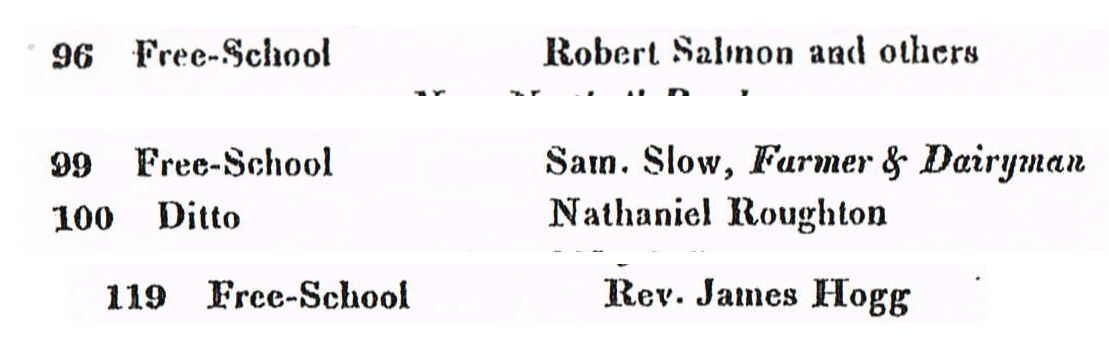
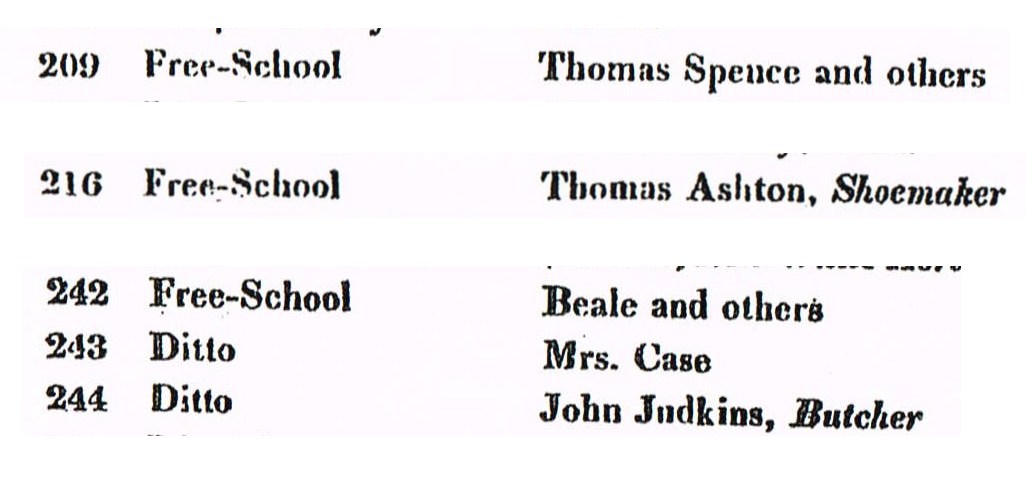
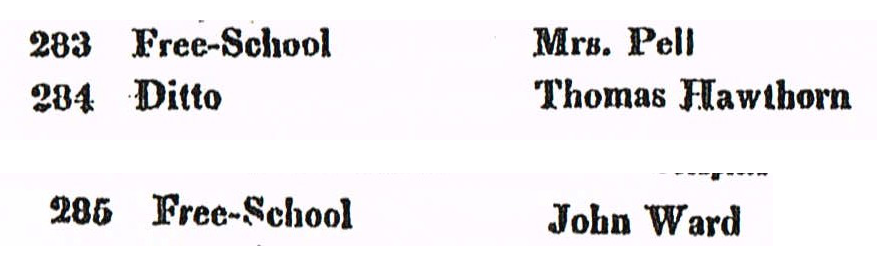
The Education Act (1944) meant that all schools would fall under the control of their local authority. This led to a long legal battle, where the council tried to seize all of the buildings which belonged to the charity.
The Foundation successfully fought off these attempts in 1955, and the properties were able to stay within the charity.
North End Infants School
St Andrew’s Infant School
Northall Street
1859 – 1975
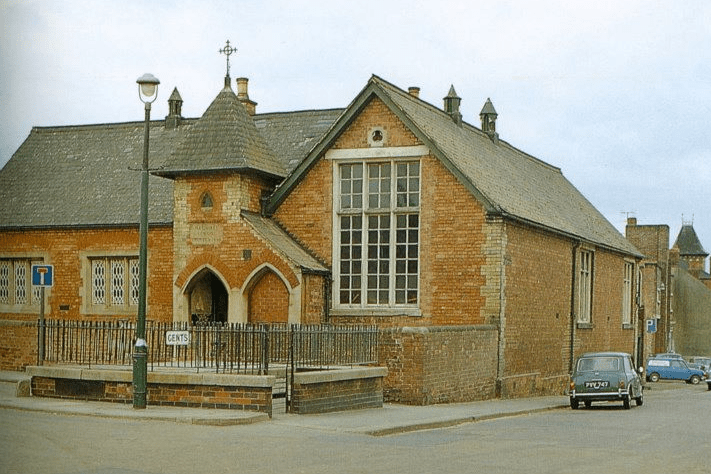
Originally North End Infant School, it later became St Andrew’s Infant School.
The building was demolished for road-widening.
Boys’ National School
The Parish Church Mixed School
Horsemarket
1876 – 1970
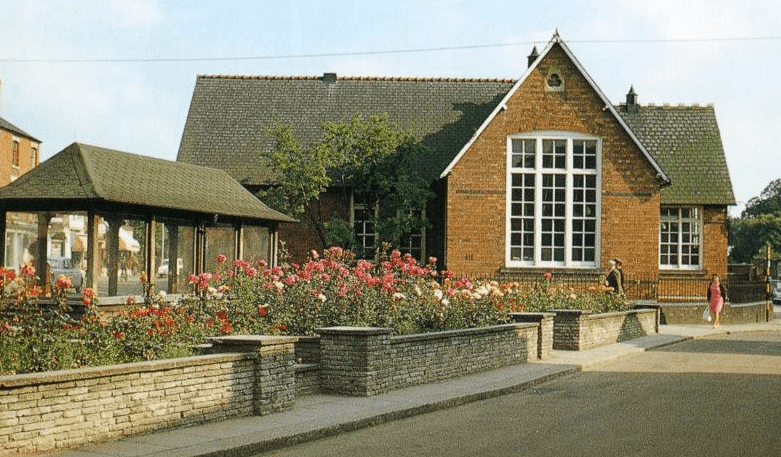
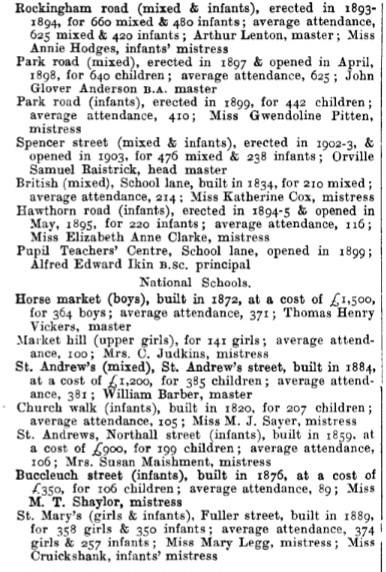
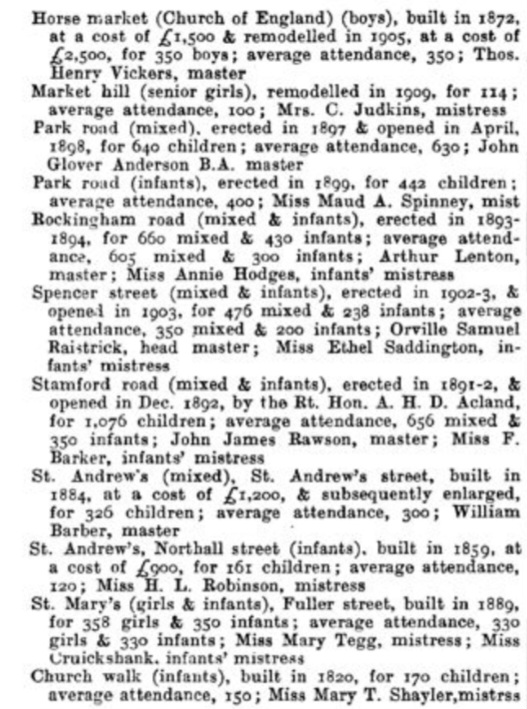
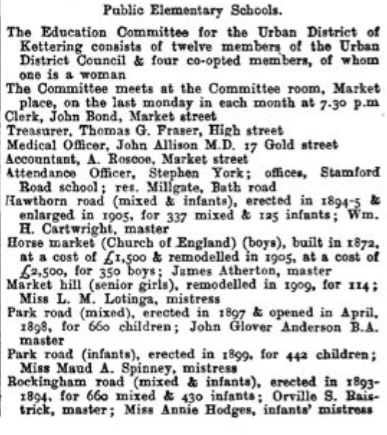
When the land to build this school was allocated, the Kettering Vestry was planning for it to be a Mixed School. But it opened as a Boys’ School, and stayed that way until 1927 when it absorbed the Girls’ School on Market Hill.
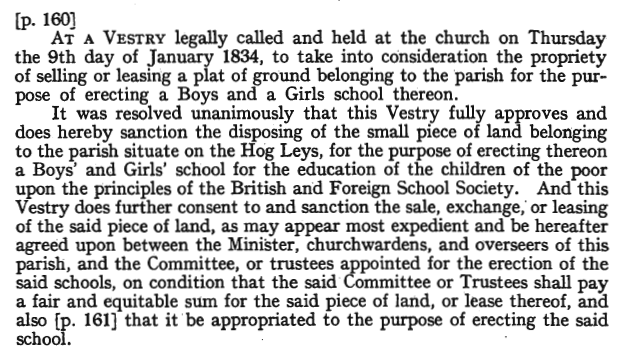
The Parish Church Mixed School closed in 1965 when it moved to its new location on the Headlands, opening as Bishop Stopford School.
The building on the Horsemarket was demolished in 1970.
St Andrew’s Mixed School
St Andrew’s Street
1886 – 1964
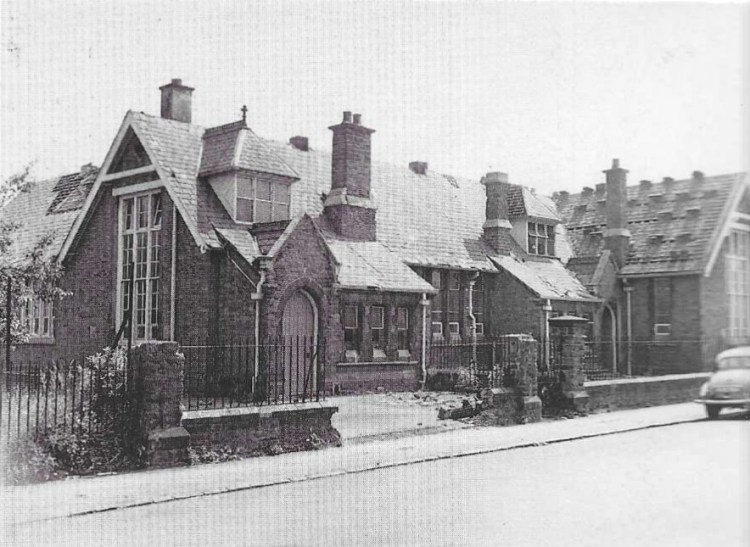
This school was demolished in 1964.
St Mary’s School (Original Building)
Fuller Street
1899 – 1979
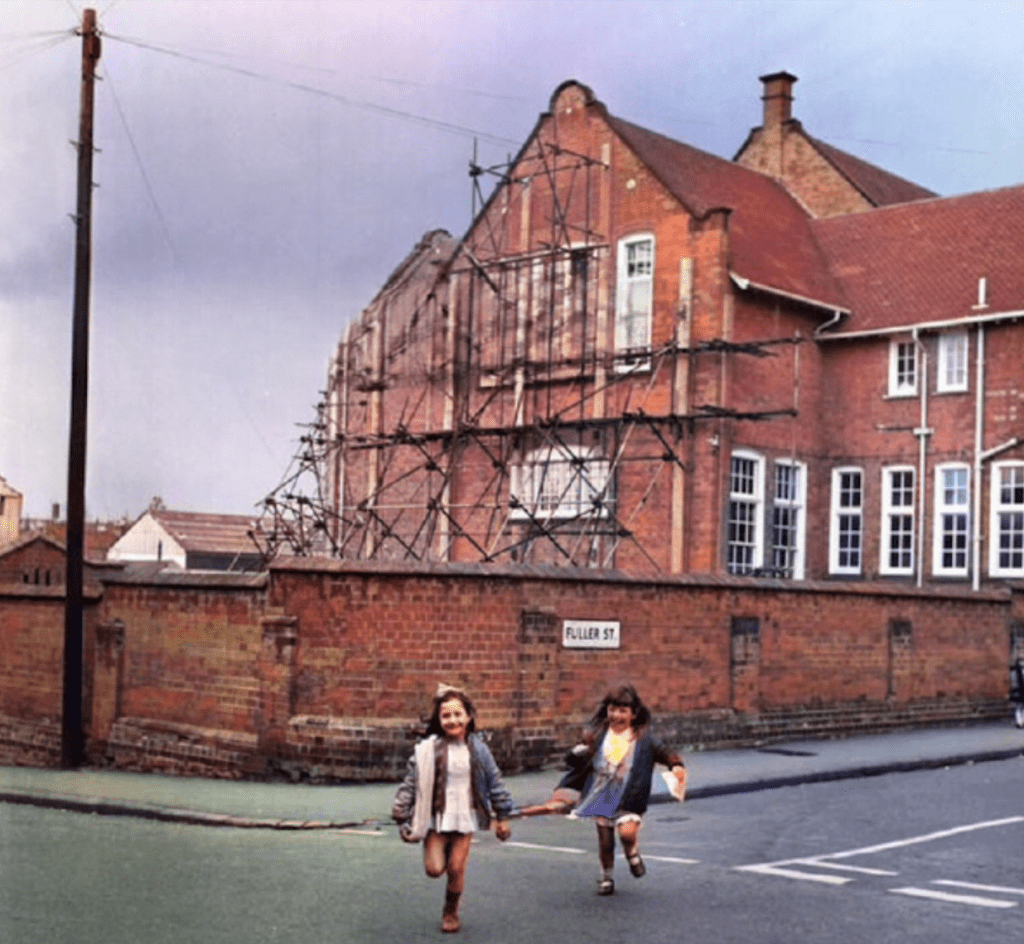
St Mary’s School opened with its original building in 1899.
By the mid 1970s, the building was showing signs of structural failure. It had to be closed and rebuilt, opening with the current building in 1979.
Hitchman’s Prep School
Victoria Hall, Gold Street
1888 – 1936
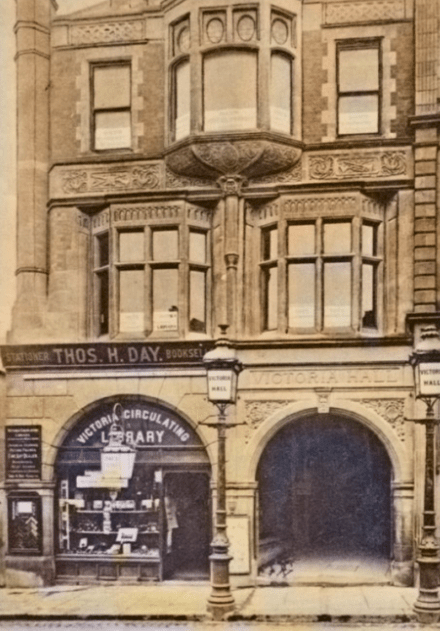
This was a private school. It shared the building with a small theatre, a stationery store, and a library.

The building was demolished as part of the town’s modernisation.
Sources – click them for link
Tony Smith’s Kettering
Cytringanian Farewell: Kettering Grammar/Boys’ School.
Harrod & Co’s Directory of Northamptonshire (1876)
https://specialcollections.le.ac.uk/digital/collection/p16445coll4/id/334844/rec/12
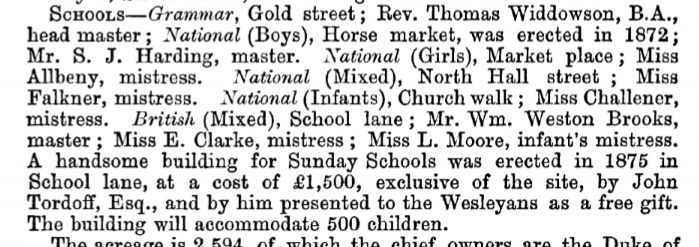
Kelly’s Directory of Northamptonshire (1890)
https://specialcollections.le.ac.uk/digital/collection/p16445coll4/id/317395/rec/3
Kelly’s Directory of Northamptonshire (1898)
https://specialcollections.le.ac.uk/digital/collection/p16445coll4/id/186181/rec/8
Kelly’s Directory of Northamptonshire (1903)
https://specialcollections.le.ac.uk/digital/collection/p16445coll4/id/336208/rec/2
Kelly’s Directory of Northamptonshire (1910)
https://specialcollections.le.ac.uk/digital/collection/p16445coll4/id/283263/rec/12
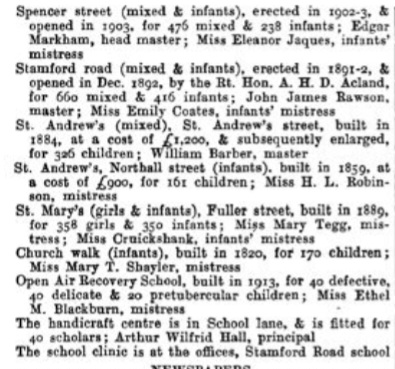
Kelly’s Directory of Northamptonshire (1914)
https://specialcollections.le.ac.uk/digital/collection/p16445coll4/id/53929/rec/14
Kettering Civic Society
Kettering High School Old Girls’ Association
Kettering Old Grammar School Foundation
Kettering Vestry Minutes 1797 – 1853
Retrieved from Northamptonshire Record Society.
Ordnance Survey Map of Kettering (1952)
Pigot’s Directory of Northamptonshire (1841)
https://specialcollections.le.ac.uk/digital/collection/p16445coll4/id/141361/rec/6
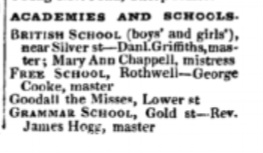
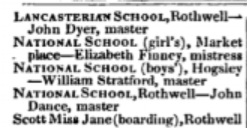
Post Office Directory of Northamptonshire (1854)
https://specialcollections.le.ac.uk/digital/collection/p16445coll4/id/179460/rec/19

 Jack Preston