
The Inclosure System was the long process of turning England’s old open fields and shared commons into private, fenced-off farms. Instead of villagers working scattered strips of land and sharing common rights, land was reorganised into blocks owned by individuals, often at the expense of poorer families who lost access to grazing and resources.
Why “Inclosure”?
Inclosure is simply the older spelling of enclosure. Until the 1800s, in- and en- were used almost interchangeably in English. That’s why the Inclosure Acts of Parliament use this form. Over time, enclosure became the standard modern spelling, but historians keep the original version when talking about the laws.
There were three main “waves” of Inclosure in England:
1. Medieval / Tudor Inclosures (c. 12th century – 1600s)
Started gradually in the Middle Ages, but really picked up in the 15th–16th centuries.
It involved fencing off open fields and common land for sheep grazing during the wool boom – these early inclosures helped the rise of Kettering’s burgeoning wool industry.
Often done illegally or semi-legally, leading to social unrest, such as Kett’s Rebellion 1549. Mainly piecemeal, landlord-led, and before Parliament got involved.
2. Local/Private Act Inclosures (1600s–mid 1700s)
Landowners increasingly pushed for legal backing through private Acts of Parliament (one-off Acts for each parish).
From the 17th century onwards, each village or manor that wanted enclosure needed its own Act. This created a “wave” of Parliamentary Inclosures, but still on a local petition basis.
3. General Act Parliamentary Inclosures (1773–1845)
The biggest and most systematic wave. A series of General Inclosure Acts standardised the process (notably 1773, 1801, and 1845). The General Inclosure Act 1801 set the model for places like Kettering. The General Inclosure Act 1845 created a permanent Inclosure Commission, streamlining the process nationally without the need for separate local Acts.
Most remaining open fields and commons were enclosed by the mid-19th century.
Kettering Inclosure Act 1804
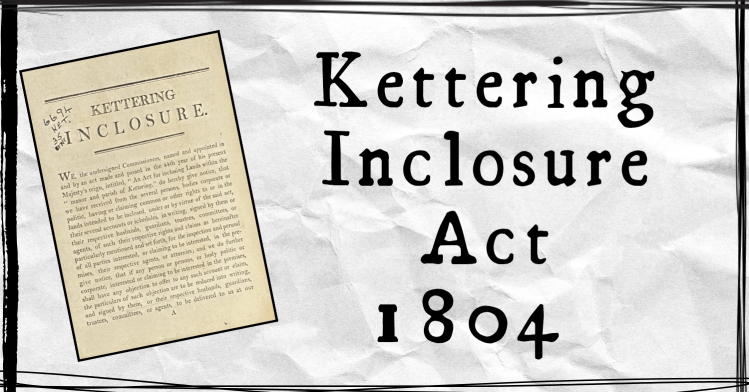
Following the General Inclosure Act 1801, local landowners (big and small) agreed to push for enclosure. They petitioned Parliament, and in 1803 a Bill was passed.
About 2,300 acres of open/common land in Kettering were reorganised into private plots.
Instead of the church being paid a tenth of crops (tithes), the Rector got a large share of land – in fact, the Rector became one of the biggest landowners in Kettering.
The real winners were the co-Lords of the Manor: the Duke and Duchess of Buccleuch of Boughton House; and Lord Sondes of Rockingham Castle.
On paper, closure helped to make local farming more efficient – before, farmers would have held scattered strips of land, possibly mixed in with this held by others. The inclosure gave them single blocks of land equalling the same amount. Boundaries were marked by fences, hedges, or ditches.
Cottagers were among those who lost out – people who lived in a cottage within the Parish, usually with little or no land of their own. Their main asset was the implicit right attached to the cottage, such as the right to graze a cow, keep a pig, or collect wood or turf on the commons.
These rights were often long-standing and based on custom, not on formal deeds, which made them hard to prove when inclosure came, so any claims or objections were rejected. They received only a tiny “Poor’s allotment” (just over 9 acres). Without common rights, poorer families lost free fuel, grazing, and food sources, forcing many into poverty sooner.
Kettering was already facing widespread poverty and industrial decline – its woollen trade had collapsed in the late 1700s. Inclosure added pressure: by 1821, nearly half the population were paupers.
The people of Kettering didn’t take this lying down – across the country, boundary markers were destroyed, and there were violent protests; Northamptonshire was apparently among the most outspoken. But when they weren’t using force to suppress these protests, Parliament and local authorities paid them as little attention as they had to legal forms of protest.
With the loss of rights they had come to expect and depend upon, many sold up or abandoned their rented properties.
Kettering’s wool industry was given a couple of mentions – read about it here!
Sources
RA Martin, Kettering Inclosure 1804-5, in Northamptonshire Past & Present, Vol V, No 5. Northamptonshire Record Society.
- https://www.northamptonshirerecordsociety.org.uk/pdf/npp/volume-5/npp-v5-n5.pdf
- https://www.northamptonshirerecordsociety.org.uk/
Neeson, J. M. Common right and enclosure in eighteenth-century Northamptonshire. PhD thesis, University of Warwick.
Neeson, J.M. THE OPPONENTS OF ENCLOSURE IN EIGHTEENTH-CENTURY NORTHAMPTONSHIRE
 Jack Preston
One thought on “Kettering Inclosure Act 1804”