

This evening (19 September) will see our local rugby team, Northampton Saints, face off against Saracens from North London.
But let’s take a look at some of the real saints from or connected to Northamptonshire…
Saint Ragener of Northampton: The Forgotten Martyr in Marefair
Walk past St Peter’s Church in Marefair, Northampton, and you’ll find one of England’s finest Norman churches.
But behind the carved stone and Green Man lies the story of a forgotten Anglo-Saxon saint: Saint Ragener, a martyr who became Northampton’s very own holy figure.
Who Was Saint Ragener?
According to legend, Ragener was the nephew of Saint Edmund, the king of East Anglia martyred by the Vikings in 870. Like Edmund, Ragener is said to have died resisting the invaders.
But while Edmund’s cult spread across England, Ragener’s body was quietly laid to rest in Northampton.
The Strange Discovery
For nearly two centuries, no one spoke of Ragener. Then, in the mid-11th century, a curious story unfolded…
A priest named Bruning, who served in St Peter’s, was told through a vision that a “friend of God” lay buried beneath the church.
When the tomb was opened, the body was found intact, with a scroll declaring: “Ragener, martyr of Christ, nephew of Edmund.”
Almost immediately, the sick began to report miraculous cures at the site, including a crippled nun, Alfgiva of Abingdon.
A local cult of devotion was born, and a shrine was built, endowed by Edward the Confessor.
What Remains Today
The church that stands today isn’t the same one in which Bruning made his discovery; the Norman church which now stands is one of a number of churches built by Simon de Senlis, on the same site.
Although the shrine itself is long gone, along with most of the rest of the old church, one extraordinary survivor of the re-build is the Anglo-Saxon carved grave slab now displayed inside St Peter’s.

Covered in intertwined beasts and foliage, the slab was discovered during Victorian-era restoration of the church. It is often associated with Ragener’s tomb, but this is speculation.
Even if we cannot be certain, whatever it truly is, it’s an authentic fragment of Northampton’s early medieval story.
St Pega of Peakirk: The Hermitess of the Fens
Note on geography: The Soke of Peterborough (including places like Castor and Peakirk) was historically part of Northamptonshire; its later administrative moves don’t erase those medieval Northamptonshire links.
Head a few miles north of Peterborough and you’ll find the village of Peakirk. Its name means “Pega’s church” — a lasting reminder of the Anglo-Saxon anchoress (religious recluse) who lived and prayed there over 1,300 years ago: Saint Pega, sister of the famous Saint Guthlac of Crowland.
Who Was Pega?
Pega was born in the late 7th century, a noblewoman of Mercian stock.
Her brother, Guthlac, gave up the warrior life to become a hermit in the wild Fens. Pega followed her own calling and became an anchoress – a woman who chose seclusion, devoting her life to prayer and fasting.
She settled at what is now Peakirk, building her cell in the fenland landscape; before later drainage and channelling efforts, the landscape would have been more watery and secluded.
Pega’s Heart
Following her brother’s death, Pega travelled to and spent the rest of her life in Rome. Her relics were enshrined, and she was venerated locally.
But her heart was returned to Peakirk. According to medieval accounts, it was buried at her hermitage.
A “heart stone”, a small medieval slab with a carved heart-shaped motif, survives today in St Pega’s Church, Peakirk. This is traditionally identified as marking the spot of her heart’s burial.
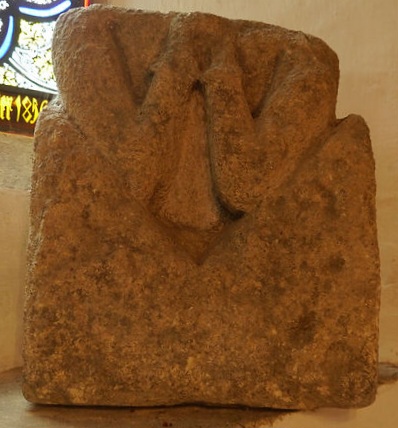
The broken remains of the Heart Stone are still kept inside the church – one of Peakirk’s treasures and a tangible link with its founding saint.
It reinforces the idea that even though her body lay in Rome, her heart belonged in Northamptonshire.
Sources
British Pilgrimage Trust, “St Peters, Northampton”
Catholic Online
Dmitry Lapa, “The Local Saints of Eastern England part 2”
Venerable Bazil Marsh, “St Ragener of Northampton Prince, Soldier, Martyr”
 Jack Preston