
Wander just outside Rushton, Northamptonshire, and you’ll find yourself facing one of the strangest, most intriguing buildings in England. It isn’t grand like a country house, nor fortified like a castle. Instead, it squats in the countryside like a puzzle made of stone: three sides, three storeys, three gables. At once eccentric and beautiful, it is Sir Thomas Tresham’s Triangular Lodge.
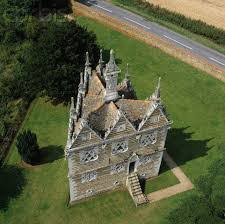
At first sight, it might seem like an Elizabethan gentleman’s whimsical folly. But every line, every carving, every angle is charged with meaning. To understand the Lodge, you must first understand the storm that raged around Tresham’s life.
Dangerous Beliefs
The England of the late 1500s was not kind to Catholics. Since Henry VIII’s break with Rome, religious loyalties had shifted with every monarch. Under Elizabeth I, the Protestant faith became firmly established, and Catholic practice was not just frowned upon, but actively punished.
Fines for “recusancy” (the refusal to attend Protestant services) were crippling. Catholic families who refused to conform were bled of wealth, marked as dangerous outsiders, and closely monitored by their neighbours. Priests had to be smuggled from house to house, hidden in cramped priest holes, always at risk of discovery.
Northamptonshire was a county with a stubborn Catholic streak, home to families who clung to the old faith. The authorities never overlooked this. Raids, fines, and arrests fell heavily here, and Sir Thomas Tresham of Rushton bore the brunt of it.
And he had plenty of stake – a lavish lifestyle was funded not only by his inherited wealth, but by his lucrative farming of livestock, sold all over the county. He had been High Sheriff of Northamptonshire, and was close with Queen Elizabeth I’s inner circle, and was knighted in 1575.
Sir Thomas Tresham – A Life of Punishment
Tresham converted to Catholicism in 1580. For this, he paid dearly. Over the years he was imprisoned more than once, and fined staggering amounts – modern equivalents running into the millions. The Crown’s officials never let him be, and his reputation as a “recusant gentleman” followed him everywhere.

Yet Tresham was not broken. He endured, and he fought back in his own way. His rebellion was not with sword or pike, but with design and stone.
A Folly with a Secret
Between 1593 and 1597, Tresham built the Triangular Lodge on his estate at Rushton. Its very shape was a statement. Three sides only: no more, no less. Each facade carried three windows. The whole structure rose three storeys high. Inside, even the rooms and fireplaces echoed the pattern of threes.
Each side of the building was 33 feet long – Christ’s age when he died, and of course, a pair of 3s.
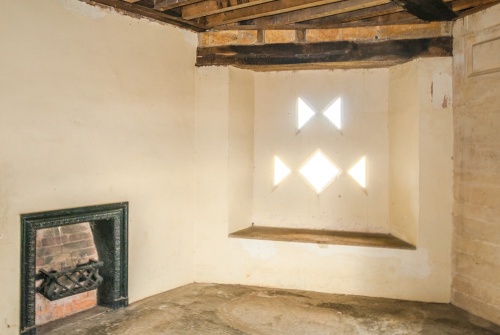
This was not whimsy. It was theology. Every triple was a tribute to the Holy Trinity – Father, Son, and Holy Ghost – at the heart of Catholic belief.
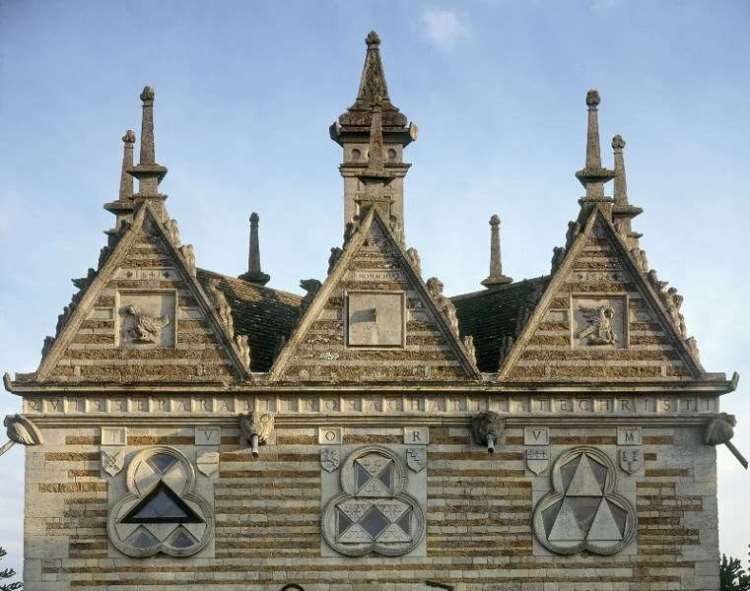
Look closer and you’ll see more: Latin inscriptions chiselled into the stone, praising God; Biblical texts of 33 letters.
Carved numbers and symbols layered with Catholic meaning. For those who knew how to read them, the walls of the Lodge were a sermon in stone.
To Protestant officials, it could be dismissed as eccentric decoration. To fellow Catholics, it was a coded act of defiance, a bold declaration that Tresham’s faith remained unbroken.
Even if directly challenged on this point, he had plausible deniability: he could claim the whole thing was a play on his name, Tres-ham.
A Lasting Defiance
The Triangular Lodge was not built to house a family or entertain guests. It was built to endure. Centuries later, it still stands: a small but striking act of rebellion carved into the Northamptonshire countryside.

For Sir Thomas Tresham, it was the one thing the Crown could not take from him. They could imprison him, bankrupt him, strip his public role. But they could not silence his faith, or erase the stone he left behind.
Sources
National Trust, “Sir Thomas Tresham”
Northamptonshire’s Historic Environment Record, “The Triangular Lodge, Rushton”
 Jack Preston