
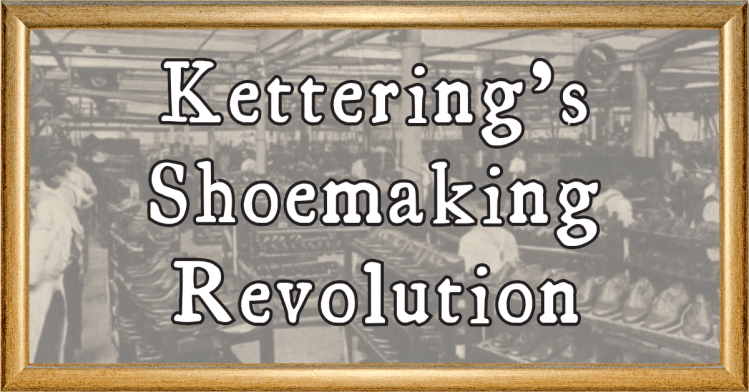
Kettering in the early Nineteenth Century was a centre of the shoemaking trade; not yet with the great factories of later years, but a growing trade that would shape Kettering’s future.
In backyards, cottages, and tiny workshops, whole families made shoes by hand. Children learned the craft beside their parents, passing down skills that had been part of Northamptonshire life for centuries.
From Cottage to Workshop
Trade directories from the early Nineteenth Century list a handful of master shoemakers in Kettering. By the mid-1800s, the number had multiplied, hinting at a thriving cottage industry. The 1841 census recorded many residents describing themselves as part of the shoemaking trade, most as outworkers for local masters. Shoemaking was becoming central to local life.
Population figures add to the story: between 1801 and 1851 Kettering nearly doubled in size, from just over three thousand people to more than five thousand. By the end of Queen Victoria’s reign in 1901, this number had reached 30,000, most of them linked in some way to shoemaking.
These were small enterprises: local, efficient, and unmechanised. The old system grew up in what was once the heart of artisan and family-based trade. Shoemaking families often worked for merchants or local factories on an “outwork” basis, making shoe parts at home for finishing elsewhere.
Then came the machines … loud, efficient, and unstoppable. The shoemaking families who’d once worked side by side now clocked in beneath factory roofs.
On Track
Even before the railway came, the town’s trade was growing fast. The turnpike roads carried boots south to London and north to Leicester, while nearby canals hauled in hides, nails, and wax.
Then came the railway, and with it, revolution. When the Midland line reached Kettering in 1857, everything quickened. Machinery arrived by train, leather came in bulk, and finished shoes sped to London in hours instead of days. What had been a thriving cottage craft became a national industry almost overnight.
The Craft That Built a Community
Shoemaking in Kettering began long before the factory age. By the Victorian period, nearly every street had at least one family involved in the trade, as stitchers, closers, cutters, or finishers. It was hard work, often on poor pay, but it gave Kettering a shared sense of purpose.
Apprentices learned their craft through repetition and patience. The smell of polish, glue, and leather filled the air. Each home workshop was part of a wider chain linking family makers, local suppliers, and growing factories.
The Steam Age of Shoes
By the late Nineteenth Century, industrialisation had transformed Kettering. Shoemaking became one of the town’s largest employers, alongside nearby Northampton and Rushden. Companies such as Loake (founded 1880) and Glover & Sons brought mechanised stitching and cutting machines to their workshops.
Output soared, but so did expectations. Productivity increased, and wages stabilised. Kettering gained a reputation for high-quality, reliable work. The town became known across Britain as part of the “boot and shoe belt” of Northamptonshire.
But mechanisation came at a cost. Handworkers who once took pride in crafting every pair now faced long hours at factory benches. The sense of independence that once defined the trade was fading.
The social world changed too. Men who had once worked alongside their wives and children now spent long hours on the factory floor, while women took in outwork: stitching and finishing shoes at home for pennies a pair.
The Home of Industry
If you look at the streets of terraced houses around the town centre, nearly all of them have a factory on or near them. This is because the houses were built between 1885 and 1895, for the factory workers.
Shoemakers and Solidarity
Progress rarely comes without conflict. The same machines that made the town prosper also made it restless. When the click of needles was joined by the clatter of steam presses, many workers feared that skill, their most precious possession, was being replaced by iron.
Workers resented the introduction of piece rates (being paid per pair instead of a steady wage) and the constant “regrading” of work that undercut experienced craftsmen. Many of these workers would have been part of the National Union of Boot and Shoe Operatives (NUBSO), one of Britain’s earliest and strongest trade unions, headquartered in Earls Barton.
In 1874, shoemakers across Britain took action for better pay and conditions. In Kettering, the strike was met with a mixture of resolve and hardship. Families pawned tools to survive; women stitched outwork for pennies; union meetings filled the back rooms of public houses.
Though the strike was eventually broken, it showed that Kettering’s workforce could stand shoulder to shoulder with their comrades in Northampton, Leicester, and beyond.
The Great Lock Out
Two decades later came another showdown: the Lock Out of 1895. This time, it wasn’t the workers who walked out; led by the Manufacturers’ Federation, it was the employers who turned the key.
A sort of “union for employers”, the Manufacturers’ Federation was a national alliance of boot and shoe factory owners, created to give employers strength in numbers when dealing with workers’ unions.
Across Northamptonshire, factory gates were closed and machines fell silent as owners tried to force through new rules on wages, hours, and machinery. These rules came in the form of the so-called Seven Commandments.
- No wage changes for two years: meaning no increases, freezing pay on employers’ terms.
- Employers have full control: they can manage factories, set rules, pay recognised rates, and bring in machinery without consultation.
- Piecework suspended: this avoided a potential wage rise based on the increased productivity, protecting employers during mechanisation.
- No interference from the union: a direct limit on union power inside factories.
- Freedom of location: employers could outsource or shift work anywhere, undermining local bargaining power.
- Right to hire freely: stopped the union from insisting on “union labour only.”
- Proof of Federation membership required for support: a small administrative clause, but the only one neutral in tone.
Some factories reopened with non-union men brought in under police escort, their hammers echoing in half empty workshops. It was a bitter sound for Kettering’s operatives, a reminder that the trade could be made to carry on without them, at least for a while.
Halls became food kitchens. Meetings filled the Market Place. It was a test of endurance, and of dignity.
After six weeks of hardship, the lock out finally ended; but not in triumph for the workers. The union, drained of funds and facing hunger in every shoemaking town, had little choice but to accept the “Seven Commandments” almost word for word.
The employers had won the day, yet Kettering’s shoemakers returned to their benches with quiet determination. They had lost the battle, but not the belief that fairness could one day be stitched back into their trade.
The Past Leaves Footprints Everywhere
The strikes and lockouts of the Nineteenth Century left their mark on Kettering. They taught the town that fairness had to be fought for, and that unity could turn ordinary shoemakers into a powerful collective voice.
Thanks for reading! Please consider joining my mailing list!
Sources
Crail, M. (2016) “National Union of Boot and Shoe Operatives”, Trade Union Ancestors
Elliott, L.V. (1949) A short history of the Boot & Shoe Industry. Transcribed by John Mackness
Fox, A. (1958) A history of the National Union of Boot and Shoe Operatives, 1874-1957. Transcribed by Jacky Lawrence
Lambert, T. (2001) “A History of Kettering”, Tim’s History of British Towns, Cities and So Much More
Lewis, G. “The End of the Road at Lawson Street”, Standard Group
Northampton Mercury, “The Shoe Trade War“, 22 March 1895
Pigot’s Directory of Northamptonshire (1840)
Rushden Research
 Jack Preston
Interesting ? My GGrandfather from Rothwell, Lincolnshire first worked in the Lincoln Workhouse as an Attendant. His future wife was a Nurse. They moved to Lenton, Nott’m and met a guy who was a Boot ‘n’ shoe Traveller. That friendship changed GGD’s life. Charlotte passed away and he mariied a longtime friend wh also lost a spouse.They bought a house In The Grove for £1,200+. A lot of money in 1888. His workshop was at the bottom of the garden as 17 people lived in the house, but he did very well at it, see pic.[tried to] !
LikeLiked by 1 person