
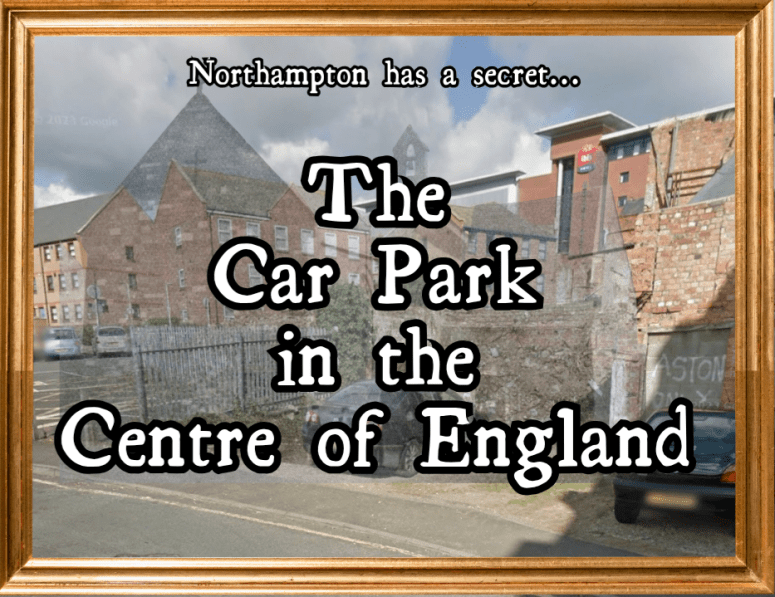
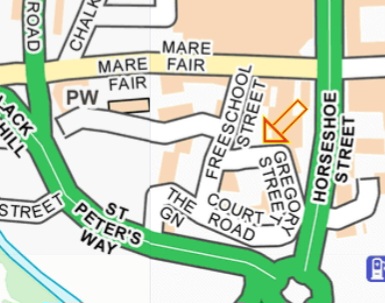
Stand in the right spot in Northampton, somewhere between Marefair, Gregory Street, and Free School Street, and you’ll find… a car park.
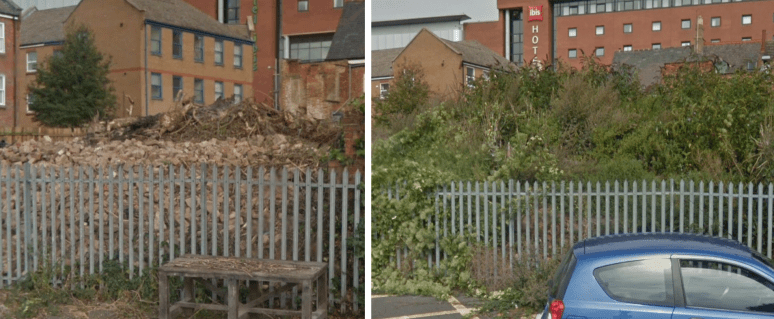
Nothing remarkable. A stretch of tarmac. Painted bays. The quiet shuffle of cars coming and going… and most important, a partially re-wilded heap of bricks and rubble.
But beneath all of this lies a story, and a place that once claimed something extraordinary: the centre of England.
A Pilgrim’s Progress
Long ago, a story was told of a pilgrim who visited the Holy Land. When he was near the site of Christ’s execution, known as Golgotha or Calvary, he was visited by an angel.
The angel instructed him to carry a stone cross to the centre of his homeland.
To fulfill this order, he carried it all the way to Northampton.
The Centre of the Homeland
It’s worth pointing out that Northampton is in no way the centre of…
- Great Britain as a whole;
- England itself;
- England south of Northumbria;
- or the Anglo-Saxon kingdom of Mercia.
But whether or not this was ever a measured “centre” in any modern sense doesn’t really matter. Medieval people understood landscapes through meanings other than things like geography, or cartography. In fact, Great Britain hadn’t even been mapped at the time of the story.
Interestingly though, Northampton is about two days walk from both Canterbury Cathedral and York Minster. These were the religious centres of the south and the north respectively, so for a pilgrim, Northampton could have been seen as a “centre between centres”.
Northampton’s Rood in the Wall
The cross’s journey ended at St Gregory’s Church, where it was embedded into a wall. It was known as The Holy Rood in the Wall, and for a time it marked the spiritual centre of the kingdom.
The Rood even caught the attention of the Monarchy. Richard III appointed a chaplain to “pray for him in a chapel before the Holy Rood at Northampton”.
From Church to Classroom
But even this didn’t save St Gregory’s.
By the sixteenth century the church fell into disrepair, with the last rector appointed in 1532. Its parish was absorbed into that of All Hallows, and the building (or what remained of it) was put to new use.
The grammar school, which had been founded in 1541, moved into St Gregory’s in 1557. Here it remained until 1864.
A couple of moves later, that school ended up in its current premises, where it’s now known as Northampton School for Boys.
After School
When the school moved on, virtually none of the original building remained. It had been mostly rebuilt in 1840, and it’s from this building that the pile of bricks and rubble come.
The bell rang for the last time, and the story all-but ended. The last of the buildings were torn down, the ground repurposed, and the past folded into whatever came next.
The area around its remains became industrialised, overlooked by a factory and surrounded by parked cars, and the quiet suggestion that something far older lies beneath it… a place where, once, someone stood and declared they had reached the centre of England.
Sources
Lark, S. (2016) Richardian and Medieval Northampton
Northamptonshire Historic Environment Record, St Gregory’s Church, north of Gregory Street
St Gregory’s Church, Church and Parish
 Jack Preston