
There have been two large scale fires in the history of Kettering. Between them, they wiped out a lot of the old town, giving way to the Victorian and Edwardian buildings that stand today.
Interestingly enough, the second of these fires was just a couple of months from being exactly a century after the Great Fire of London!
The First Fire
26 July 1744
The First Great Fire of Kettering broke out on a summer evening, and lasted for four hours.
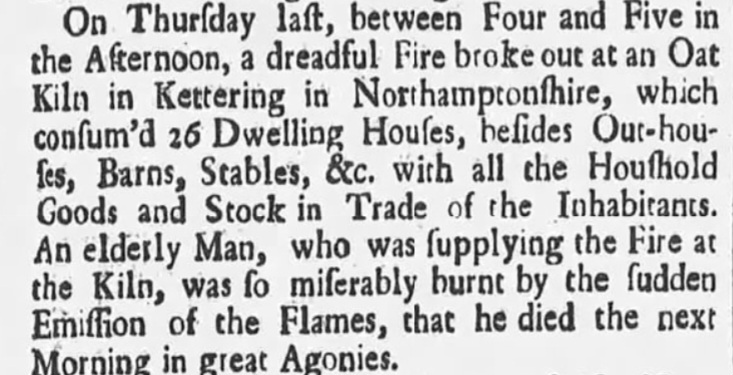
The fire started in a kiln used for drying oats. A map of Kettering from the 1720s shows a kiln near the end of what is now Lower Street. The close together buildings and land seem to match the descriptions of what was burned in the fire.
So while it’s not certain that this kiln was the one that sparked the fire, it’s a fair assumption based on what we know!
Also – this is likely a coincidence, but the point where Lower Street meets High Street was then called Bakehouse Hill!

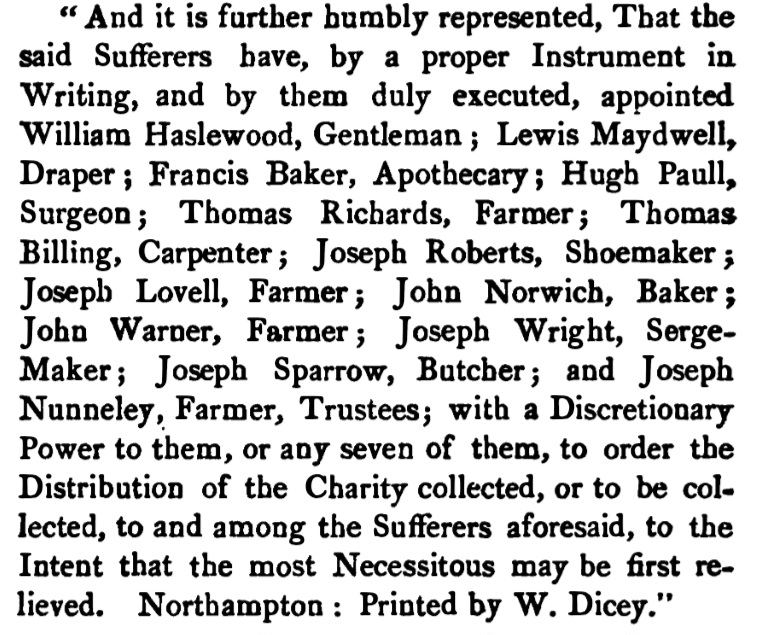
It didn’t take long for Kettering’s (still surviving!) community spirit to spring into action. A formal appeal was printed in the local papers, detailing the damage and the needs of the victims. A team of trusted volunteers, pillars of the community, was appointed to collect and distribute the charity.

The Second Fire
05 November 1766
The Second Great Fire of Kettering started on Guy Fawkes Night. The Mayor had ordered that no bonfires were to be built, and no squibs or crackers (fireworks) were to be thrown.
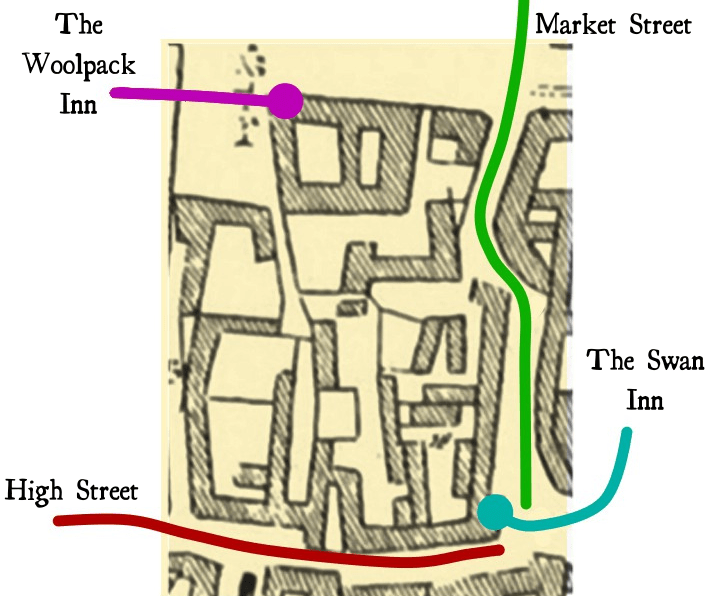
But some young boys were playing with fireworks. One of their squibs ignited a thatch roof near the Swan Inn, which was on the corner of High Street and what is now called Market Street.

The thatch roof was quickly torn down to stop the fire from spreading. This seemed to have worked, but some embers were still smoldering.
It wasn’t long before the fire reignited. This renewed blaze lasted for several hours.
It spread at least as far as the Woolpack Inn (the pub which housed the town’s Bridewell) on Horsemarket.
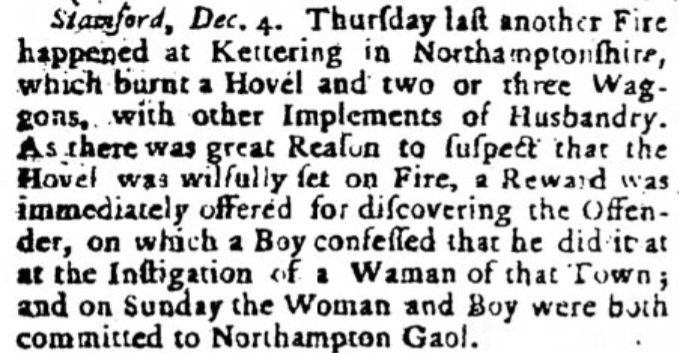
In less than a month, another (much smaller) fire hit Kettering. But this time, it was deliberate…
*
Note: this piece has been amended due to further research.
Sources
https://www.british-history.ac.uk/vch/northants/vol3/pp218-226
newspapers.com
 Jack Preston