The world’s oldest verified person lived to be 122; but according to a monument in Northampton, a local button-maker managed at least 126 years!
So, did Northampton produce the oldest man in human history?
In the portico of all Saints’ Church, Northampton, there is a memorial to a man who, if its inscription is to be believed, achieved something that nobody in recorded history has ever conclusively surpassed. His name was John Bailes, and when he died in April 1706, he was reputed to be somewhere between 126 and 130 years old.
That would make him older than the oldest verified person who has ever lived. Not just the oldest man, but the oldest human being, male or female.
John Bailes claimed that at twelve years old, he witnessed Queen Elizabeth I reviewing her troops at Tilbury in 1588, when England was preparing to repel the Spanish Armada.
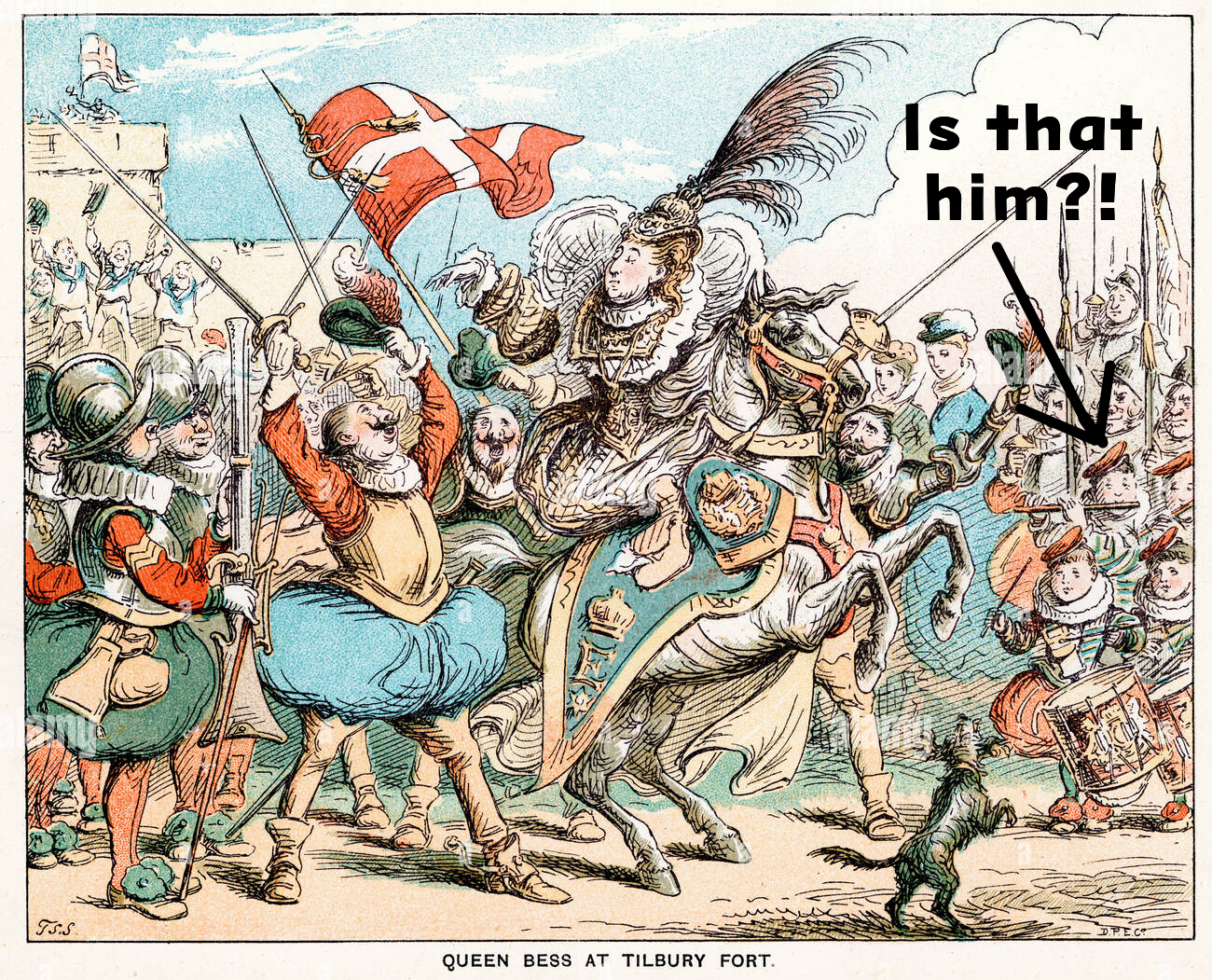
Throughout his life, Bailes repeatedly insisted that he had been present, and could recall particular details of the occasion. If he had been 12 at the time, that would place his birth around 1576. And that would make him approximately 130 when he died.
It is an appealing story; Northampton boy watches Elizabeth I rally her troops, then lives long enough to see Queen Anne sitting on the throne, with many political changes along the way!
Unfortunately, remembering a fairly well-documented event does not necessarily establish when somebody was born, particularly when the event happened more than a century earlier!
After Queen Elizabeth I died, King James VI of Scotland became King James I of England. Accordingly, he headed south to London. On the way, members of the Royal Family stopped at Holdenby House. From there, they passed through Northampton, and “received in state” by the town.
John Bailes apparently played a role in this, for he claimed to have been one of the 24 Morris Men who danced the new King’s entourage into the town!
How Did He Do It?
John Bailes attributed his long life to his simple diet of brown bread and cheese; he only drank water, milk, and small amounts of beer. While not avoiding it completely, he didn’t “much care for” meat, and had never been drunk.
Though this might have been partially due to frugality – on market days, he apparently would drink ale and eat meat, but only when they were free!
A sensible Northamptonshire approach to both health and household finances.
Whatever the case, he must have been doing something right; at age 100, he would walk his wheelbarrow full of buttons from Northampton to Wellingborough Market.
Go See Now This Aged Man
John Bailes was certainly famous enough for his story to travel well beyond Northampton.
Word of his longevity seems to have even reached Leeds! Ralph Thoresby, who is noted as being the city’s first historian, who made a point of transcribing the Bailes’ epitaph when his travels took him to Northampton.
On his way north, physician Edward Baynard stopped at Northampton. He really wanted to meet John Bailes, so asked the landlord of his inn to introduce him to the “famous old man who had been much talked of.”
Baynard seemed impressed by the man, and agreed that he was “not far short” of his stated age of 128. He found Bailes to be “strong in voice”, speaking “heartily and loud”. Baynard approved of Bailes’ stated diet, and found his breathing to be strong and “very liberal”.
The meeting seems to have piqued Baynard’s curiosity, as he went asking around the town and found that a lot of people of all ages couldn’t remember him as anything but an old man. This makes sense: the average life expectancy of the time was under fifty, and fifty years ago he would have been in his seventies!
Baynard recorded this meeting for his contribution to the second edition of a book called Psychrolousia, or, The history of cold bathing. Writing in about 1706, the year of John Bailes’ death, Baynard described the encounter as being just over two years ago; if anything, this helps to strengthen the possibility that Bailes had reached 130, if he had been 128 a couple of years before!
The Doctor Who Examined Him
Following Bailes’ death on 4 April 1706, Northampton physician Dr James Keill conducted a post-mortem examination.
Like Baynard, Keill acknowledged that Bailes was widely believed to have reached 130; he also interviewed elderly Northampton residents, including people in their eighties, nineties and even one hundred, who remembered Bailes being an old man when they themselves were young.
Although their recollections differed, Keill reported that they agreed he was at least 120.
Keill also recorded that Bailes continued walking to neighbouring markets to sell his buttons until roughly twelve years before his death. And even some of that time, he was “carryed” to them.
His final years, however, were marked by increasing frailty.
The examination revealed a severely emaciated body, with considerable changes to his blood vessels and other organs.
Keill concluded that Bailes had died from problems associated with extreme old age.
Unfortunately, even a thorough post-mortem examination cannot tell us whether somebody is 100, 120 or 130.
And Keill himself admitted the crucial difficulty: there was no surviving parish register old enough to establish when Bailes had been christened.
Sources
- Cox, J.C. (1898) The Borough Records of Northampton, Volume 2
- Floyer, J. and Baynard, E. (1706) Psychrolousia, or, The history of cold bathing : both ancient and modern : in two parts
- The Diary of Ralph Thoresby
- Keill, J. (1706) “An Account of the Death and Dissection of John Bayles, of Northampton, Reputed to Have Been 130 Years Old”, Philosophical Transactions of the Royal Society
- https://royalsocietypublishing.org/rstl/article/25/306/2247/110372/VIII-An-account-of-the-death-and-dissection-of


Leave a Reply