
Street names often come from notable buildings, landmarks, or residents. So it will come as no surprise that Kettering’s School Lane was once home to two schools.
John Tordoff
We can’t talk about the schools of School Lane without talking about John Tordoff, who lent his name to a street which runs off it.
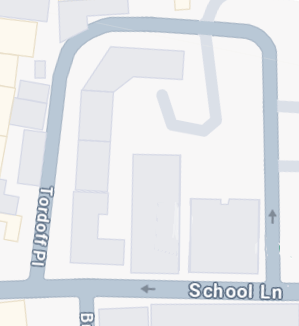
Tordoff was chapel steward of the Wesleyan Methodist Church, and according to the 1851 census, was a member of the town’s “gentry”. He donated £1000 toward the building of the Wesleyan church on Silver Street; quite fitting, when this church was demolished for road widening, a replacement was built on School Lane, opposite Tordoff Place.
The Sunday School
The Sunday School for Wesleyan Methodists was built by Tordoff in 1875.
The building still stands, and is home to a gym.
It might seem unusual today for an entire building to be used for a Sunday School, but they were an important part in the education of children from less well-off families. At a time when children might be required to work through the week, or when families might not be able to afford schooling, they allowed children to learn basic reading, writing, and arithmetic.
The British School
Having been providing education to followers of “dissenting” religions since 1834, it was either extended or partially rebuilt by Tordoff around the time the Sunday School was built; there is a date stone above a door baring the date 1874.

This gives the building some significance, as it is one of the few identifiable British Schools in Northamptonshire.
● The Former Schools of Old Kettering ● The Lost Schools of Old Kettering ● The Sunday Schools of Old Kettering
● My Books ● More Local History ●
Sources
Architects of Greater Manchester (2026) Wesleyan Chapel, Silver Street, Kettering
Bull, F.W. (1891) History of Kettering
Foard, G. and Ballinger, J. (2000) Northamptonshire Extensive Urban Survey: Kettering
Greenall, R.L. (2003) A History of Kettering, Phillimore & Co
- ISBN 1860772544
Valentine, D. (no date) The Utility of the Religious Census of 1851 with reference to Kettering.

