
Today, Lilbourne is a small Northamptonshire village near the Warwickshire border. It is quiet, rural and not generally somewhere you would associate with civil wars.
But around 900 years ago, somebody built a castle here.
Then somebody else appears to have built another castle less than a kilometre away … possibly for the specific purpose of attacking the first one.
Welcome to the Anarchy, England’s first civil war.
Heir Today, Gone Tomorrow
The trouble started in 1120 with the White Ship Disaster.
The ship sank in the English Channel, taking with it William Adelin, the only legitimate son of King Henry I.
This left Henry with something of a succession problem. He still had a legitimate daughter, Empress Matilda, and declared that she would succeed him.
England’s leading nobles were made to swear that they would accept her. Henry died in 1135. And it turned out that many of the Barons had their fingers crossed.
Henry’s nephew Stephen of Blois hurried across the Channel and had himself crowned King Stephen, with the support of a number of these Barons.
What followed was a civil war between supporters of Stephen and supporters of Matilda, which became known as the Anarchy.
Neither side was powerful enough to rule the country or finish the other off. For years, royal authority was weakened, and England became divided between competing factions and powerful local lords.
And when medieval Barons discovered that nobody was keeping a particularly close eye on them, they did what medieval Barons did best: whatever they wanted.
And this involved building castles.
Adulterine Castles
While their name suggests somewhere you might sneak off to have an affair, Adulterine Castles were a bit more complicated.
Medieval Barons could build all the manor houses or hunting lodges they wanted, but not castles.
Castles allowed Barons to surround themselves with walls, ditches, and soldiers. This would make it harder for the king to tell them what to do.
Castle building was therefore subject to royal authority. Unfortunately for King Stephen, royal authority was precisely what England was running short of.
During the Anarchy, Barons sneakily built new castles and strengthened existing ones. These unauthorised fortifications became known as Adulterine Castles.
And Northamptonshire appears to have acquired a particularly interesting pair.
The Castles of Lilbourne
Castle One
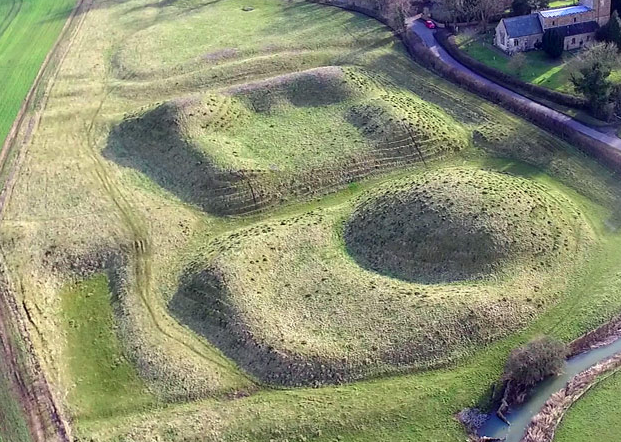
Lilbourne’s main castle, a motte-and-bailey, stood beside the village and close to a crossing of the River Avon.
The motte was a huge artificial mound topped by the castle’s principal strongpoint, probably made largely from timber. Alongside it was the bailey, a defended enclosure containing other buildings, supplies, animals and people.
Despite having existed before the Anarchy, Historic England describes this castle as “probably adulterine”. This could be because the fortifications and defences were strengthened without royal permission; substantial changes to existing castles needed royal permission just like building new ones did.
The castle was owned by the Camville family, who seem to have been on the side of King Stephen.
And less than a kilometre away is…
Castle Two
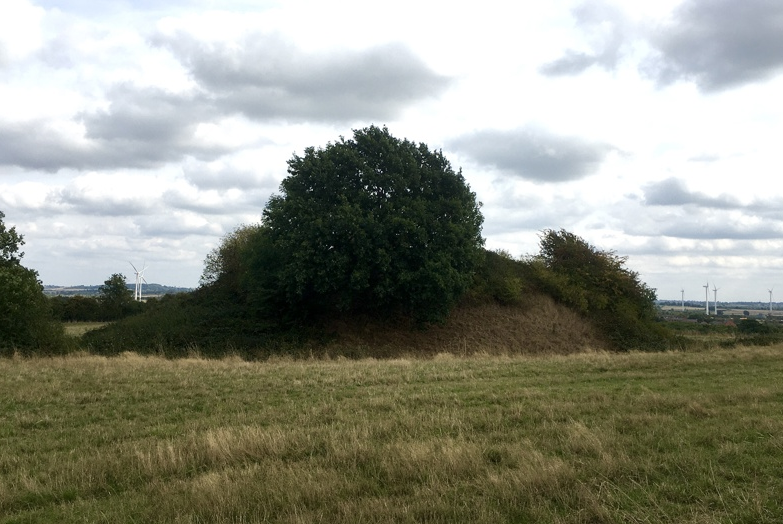
Head about 800 metres west and you encounter another substantial motte-and-bailey earthwork near Lilbourne Gorse.
These weren’t necessarily two neighbours who both happened to fancy castles. A survey of these earthworks suggests that the second motte was deliberately constructed to lay siege to the first castle.
This pair of castles suggests a story, which was being told across the whole country.
Neighbours from Hell
Given the probable age of the two castles, it’s possible they were from opposing sides of the Anarchy.
Richard de Camville was expressing his support of King Stephen. Supporters of Empress Matilda would have wanted to weaken Stephen’s power in the local area, so built their own castle nearby.
But that’s all conjecture. There are no known battles associated with the two castles, and neither one is recorded as successfully attacking the other.
That said, a mental image of two opposing Barons glaring and shaking their fists at each other across the space between their castles isn’t actually contradicted by anything…
All Good Things
Eventually, the Anarchy ended.
Matilda’s son became King Henry II. And he was less than enthusiastic about Barons covering his kingdom in their own private fortifications.
Royal authority was reasserted and numerous castles associated with the disorder of Stephen’s reign were demolished or abandoned.
Neither of those in Lilbourne developed into a great stone fortress.
Whatever buildings once stood on the enormous earthworks disappeared. The castles ceased to be castles and became strange bumps in the Northamptonshire landscape.
Nine centuries later, you can still see the remains of two castles within sight of one another.
• More Local History • My Books •
Alexander, J. (2024) Lilbourne Village History
Archer, G. (2020) Lilbourne Castle
Historic England (1992) Lilbourne motte and bailey castle and fishpond
Historic England (1992) Motte and bailey castle south of Lilbourne Gorse
Patin, J.F. (2022) Sir Richard de Camville of Oxfordshire
Ross, D. () Adulterine Castles
Walker, I. (2022) Lilbourne Gorse

